
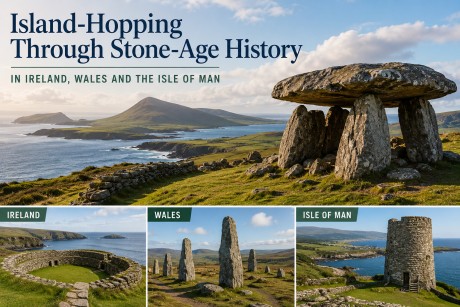
Embarking on a journey around the Irish Sea presents an intriguing opportunity to delve into the prehistoric landscapes of the British Isles. This captivating route, which navigates through Ireland, Wales, and the Isle of Man, is rich with ancient tombs, Celtic monuments, and historic sites, all set against the backdrop of picturesque ferry rides.
The adventure kicks off in Pembrokeshire, Wales, where travellers encounter Pentre Ifan, a stunning Neolithic burial site that dates back to approximately 3500 BC. This monument, with its massive stones set in a remote location, serves as an introduction to the prehistoric wonders surrounding the Irish Sea. From Wales, the journey transitions by ferry to Ireland, which boasts some of Europe’s most remarkable Neolithic sites.
In Ireland, Newgrange stands out north of Dublin as a must-see. As a massive passage tomb built over 5,000 years ago, it features a lengthy corridor that leads to a central chamber adorned with ancient carvings. Notably, Newgrange is famed for its winter solstice phenomenon, when sunlight streams through an entrance opening to illuminate the chamber, highlighting the builders’ impressive astronomical expertise. Other noteworthy Irish stops include the historic monastic site at Glendalough in County Wicklow, Trim Castle, and the Hill of Tara, known for its ties to Ireland’s ancient kings.
After exploring the historic sites of Ireland, the route proceeds to Belfast and then across the Irish Sea to the Isle of Man. This island offers a divergent glimpse into ancient history, with its prehistoric monuments often located in serene countryside settings and equipped with basic visitor facilities. On the Isle of Man, visitors can discover Celtic crosses, explore archaeological sites, and visit the Manx Museum, all while immersing themselves in the island’s unique cultural heritage.
Among the intriguing destinations on this journey is Cashtal yn Ard, a Neolithic passage tomb nestled within the Manx countryside. Although partially collapsed, the remaining stones of this site reveal the original entrance, passage, and burial chamber layout. Its tranquil setting amid fields and hills offers visitors a chance to experience the site without the larger crowds typically found at major archaeological attractions. For those captivated by archaeology, history, and extraordinary landscapes, this island-hopping expedition around the Irish Sea provides a window into thousands of years of human history, seamlessly blending prehistoric monuments with scenic travels.